
In the news: Regulation Crowdfunding in 2026: Why Reg CF Now Beats Reg D
Thanks so much to Regulatory Compliance Analyst James Wright at Angel Investors Network for this feature. A portion of it is below. To read the full article, go here.
Etherdyne Technologies, the Stanford-founded wireless power startup, oversubscribed its first StartEngine Regulation Crowdfunding campaign in March 2026, raising $1.2M from 400+ investors a week before the scheduled close. The oversubscription signals a fundamental shift in early-stage capital formation: Reg CF's transparency and social proof are now attracting more sophisticated capital than traditional Reg D quiet rounds.
What Happened: The Etherdyne Case Study That Changes Everything
Traditional Reg D Rule 506(b) offerings happen in quiet rooms. Term sheets get negotiated behind closed doors. Lead investors extract preferential terms. Founders sign NDAs. The round closes, a press release goes out six weeks later, and the cap table remains opaque until the next financing event forces disclosure.
Etherdyne's approach inverted this model entirely. The company made its offering publicly available on StartEngine, where any investor—accredited or non-accredited—could review the Form C filing, examine the terms, read updates, and participate on identical terms. No special deals for insiders. No preferential liquidation preferences negotiated in private. Every investor saw the same pitch deck, the same financials, the same risk factors.
The result: oversubscription from a diverse investor base that included technical experts, industry veterans, and retail participants who understood the wireless power thesis well enough to commit capital alongside accredited investors.
What Made Etherdyne's Campaign Oversubscribe?
Etherdyne didn't succeed because Reg CF is easier. The company succeeded because it had genuine technology differentiation and told that story effectively in a public forum.
The company holds 44 granted patents for its Ether Power Platform. The technology delivers up to 100 total watts across multiple devices simultaneously within a three-dimensional charging zone—what the company calls an "Ether Power Zone." Devices receive between 0.1 watts and 50 watts each, covering the power range for most consumer electronics.
"The wireless power industry has been advancing very gradually with a focus on 1:1 charging, which is not solving the bigger picture of having a cordless environment," noted Dinesh Kithany, industry analyst at Wired and Wireless Technologies, in Etherdyne's announcement. "Etherdyne's solution is very interesting because they are doing one-to-many. That is the future of wireless power."
The company already secured FCC and CE regulatory approvals—critical validation for a technology that transmits power through magnetic resonance. The licensing model targets device manufacturers across industries rather than direct consumer sales, creating scalable revenue potential without manufacturing infrastructure.
But here's what mattered for the Reg CF campaign: Etherdyne could tell this story publicly, in technical detail, to an audience that included electrical engineers, product designers, and electronics industry veterans who understood the significance of one-to-many wireless power charging.
Traditional Reg D rounds optimize for speed and simplicity with lead investors who set terms. Reg CF campaigns optimize for conviction and community. Etherdyne attracted 400+ investors who believed in the technology thesis strongly enough to invest without a lead institutional investor signaling validation.
These are just snippets from the in-depth article. Read the full article on Angel Investors Network.
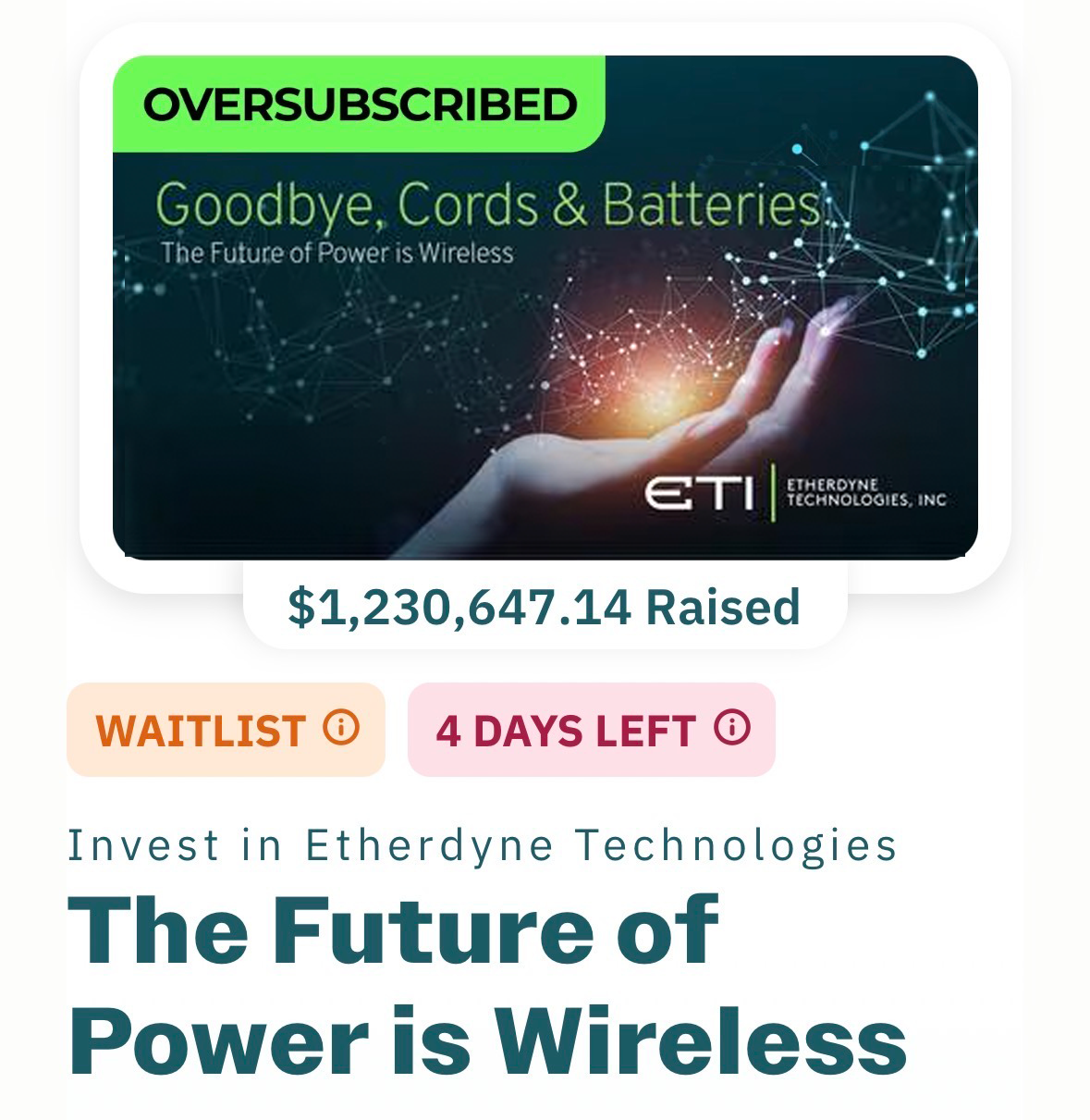


Our crowdfunding campaign was featured on Angel Investors Network. The article highlights the importance of social proof when attracting capital.
“The company succeeded because it had genuine technology differentiation and told that story effectively in a public forum.”